

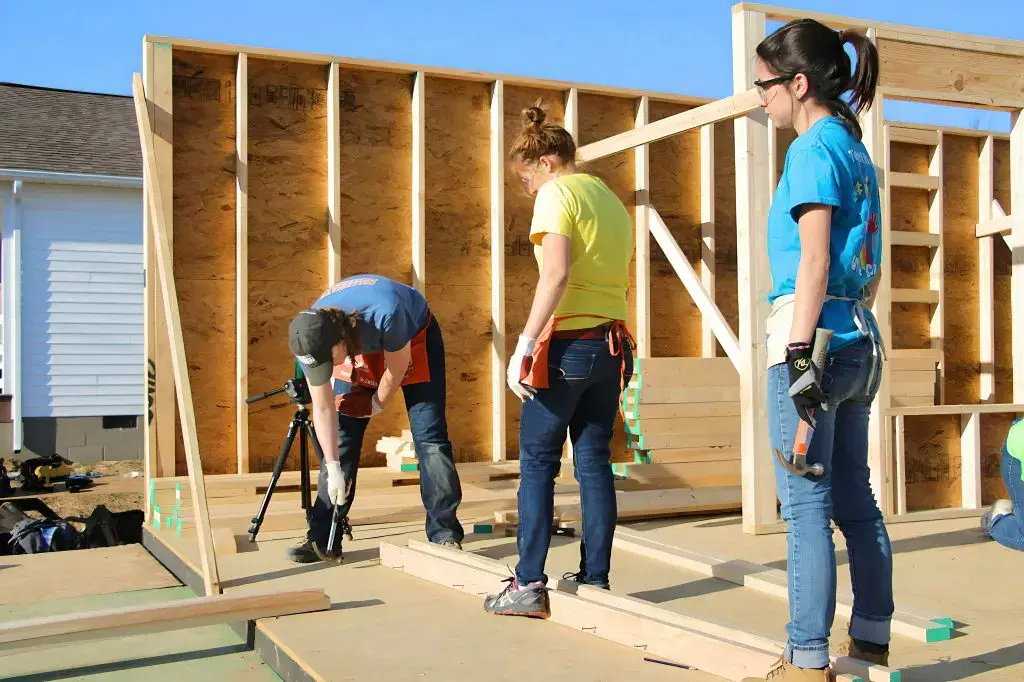
Could Encouraging More Girls Into Construction Help Close the Skills Gap?
When a young girl is asked what she wants to be when she grows up, construction probably isn’t one of the first careers that comes to mind.
Doctor. Teacher. Lawyer. Vet. Designer.
But how often do we hear a young girl say she wants to be a site manager, electrician, civil engineer or construction project manager?
And perhaps that’s part of the problem.
The construction industry is facing a significant skills shortage and needs to attract the next generation of workers. At the same time, women remain underrepresented across the industry.
So could encouraging more girls to consider construction help the industry tackle its skills gap?
Potentially – but first, girls need to know that construction is an option.
If you don’t see it, you might not consider it
For generations, construction has often been viewed as a man’s industry.
That perception doesn’t necessarily come from anyone explicitly telling girls that construction isn’t for them.
Sometimes, it’s simply about what they see.
If the people they see working on construction projects are predominantly men, and the careers they’re introduced to at school don’t include construction, why would they automatically picture themselves working in the industry?
There’s also a long-standing emphasis on encouraging young people towards university and traditional professional or office-based careers. For some girls, construction simply isn’t presented as an alternative.
That’s something we need to change.
Start encouraging girls early
If we want more women entering construction in the future, we shouldn’t necessarily wait until they’re choosing their first career.
We can start much earlier.
One example is a Girls in Construction event, where three local primary schools took part in hands-on activities designed to challenge stereotypes and encourage the girls to consider careers in construction.
That’s exactly the kind of early exposure that can make a difference.
A girl who has never thought about construction might discover that she enjoys building something, solving a practical problem or learning how something works.
She might not decide at nine or ten years old that she wants to become an engineer.
And she doesn’t need to.
The point is simply to make sure construction is one of the options she knows exists.
Construction isn’t just one career
One of the biggest misconceptions about construction is that it’s simply about working on a building site.
In reality, the industry offers an enormous range of career paths.
A girl interested in maths and science could explore engineering.
Someone who enjoys organising people and solving problems could look at site or project management.
Someone interested in technology could explore digital construction, surveying or design.
Someone who prefers practical work could train in a skilled trade.
And someone passionate about keeping people safe could build a career in health and safety.
There are also careers in environmental management, planning, quantity surveying, procurement and many other areas.
Construction isn’t one career. It’s an entire industry of careers.
And that is something young girls need to see.
What if the next generation wants something more hands-on?
There’s another reason it’s worth challenging the traditional idea of what career success looks like.
Not everyone wants a desk-based career.
In research into young people’s career choices, 31% said they were attracted to careers that aren’t deskbound.
That’s an important point for an industry like construction.
There are opportunities to work outdoors, solve practical problems, use technology, work with your hands and see tangible results from what you’ve done.
Construction can offer something very different from sitting behind a desk all day.
For a young person who enjoys being active and practical, that could be a major attraction.
AI is changing how young people think about careers
Artificial intelligence is also becoming part of the conversation around future careers.
According to research into young people’s career choices, 28% said they were more attracted to careers in industries that aren’t threatened by AI.
Construction isn’t immune to technological change. AI, automation, digital modelling and other technologies are already changing the way the industry works.
But construction also needs people with practical, technical and problem-solving skills to apply those technologies in the real world.
That creates an opportunity to show young people that construction isn’t an outdated industry.
It’s an industry changing alongside technology.
Maybe more women would choose a trade if they’d had the opportunity
There’s another interesting statistic worth considering.
38% of surveyed women said that, if they had the chance, they would go back and learn a trade.
That raises an important question:
How many girls are currently making career decisions without ever being properly introduced to skilled trades?
For generations, university has often been presented as the natural next step after school, while practical careers and trades haven’t always received the same attention.
But an apprenticeship or trade can offer a very different route into a rewarding career.
And it doesn’t mean closing the door on progression.
Someone can start with a practical qualification, gain experience and continue developing their career into supervision, management or another specialist area.
Female role models matter
If we want more girls to consider construction, we need more women talking about their experiences.
Not just CEOs and senior executives.
We need to show girls women working at every level:
The apprentice.
The electrician.
The engineer.
The site manager.
The surveyor.
The project manager.
The business owner.
Because when a girl sees someone doing a job and thinks, “I could do that,” the career suddenly becomes much more real.
A lack of female role models can make it harder for girls to picture themselves in an industry where they don’t see many women.
That doesn’t mean every girl needs a female role model to enter construction.
But giving girls the opportunity to meet women already working in the industry can help challenge the idea that construction is only for men.
But we also need to be honest about the challenges
Encouraging more girls into construction doesn’t mean pretending that the industry has no barriers.
The male orientation of the industry can create challenges for women, from workplace culture and the risk of sexual harassment to practical issues such as PPE.
Ill-fitting PPE isn’t simply an inconvenience.
If protective equipment hasn’t been designed or selected with different body shapes in mind, it can create genuine health and safety risks.
These are issues the industry needs to take seriously if it wants to attract and retain more women.
Encouraging girls to enter construction is only one part of the solution.
Keeping them there matters too.
That means creating workplaces where women can develop their skills, progress their careers and be treated with the same respect and professionalism as their male colleagues.
What can we do to encourage more girls?
The industry doesn’t necessarily need to wait until girls are old enough to apply for their first job.
It can start much earlier.
Give girls hands-on experiences
Events such as Girls in Construction activities can give primary school pupils the opportunity to build, create, experiment and solve problems.
The aim isn’t to convince every girl that she should work in construction.
It’s to let her experience it.
Introduce girls to women working in construction
A conversation with a female engineer, electrician or site manager could be enough to make a young person think differently about their career options.
Show the reality of modern construction
Show the technology.
Show the engineering.
Show the problem-solving.
Show the people.
Show the finished projects.
Construction has changed, and young people need to see that.
Talk about trades alongside university
University can be the right route for some people.
So can an apprenticeship.
So can learning a trade.
Young girls should be given information about all of these options rather than feeling that a traditional university or office-based career is the only measure of success.
Make construction a career they know about
Ultimately, this might be the most important step.
Girls can’t consider a career they don’t know exists.
Closing the skills gap means reaching people we haven’t reached before
The construction skills gap won’t have one simple solution.
The industry needs to attract new workers, develop existing skills and retain experienced people.
But attracting more girls into construction could help widen the pool of people considering careers in the industry.
And perhaps the biggest change we need to make is simple:
Make sure girls know construction is an option before they’ve already decided it’s not for them.
The next generation of construction workers could currently be sitting in a primary school classroom, taking part in a hands-on activity and discovering that they enjoy building something.
They could be thinking about a future career that doesn’t involve sitting behind a desk.
They could be looking for a career that combines technology with practical skills.
They could be inspired by meeting a woman who has already built a successful career in construction.
They might not know yet.
And that’s okay.
Our job isn’t to decide their careers for them.
It’s to make sure they have enough information, opportunities and experiences to make those decisions for themselves.
Because if the construction industry needs more skilled workers in the future, we need to make sure today’s girls know they can be part of building that future.