

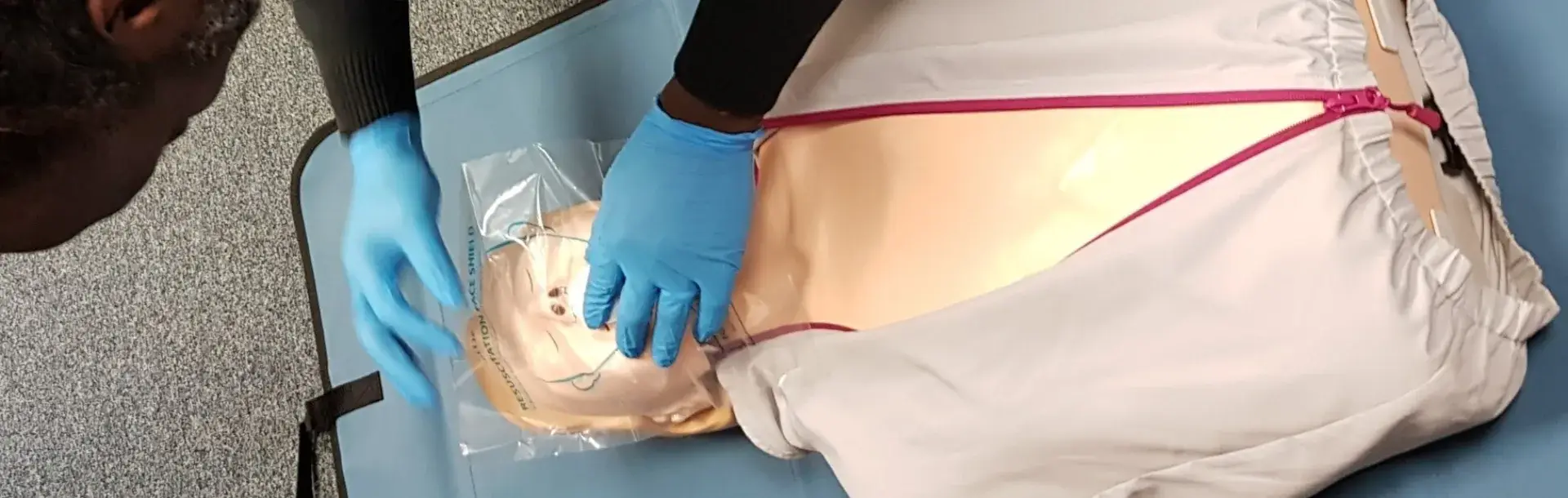
EFAW vs FAW: Which First Aid Course Does Your Team Need?
Choosing between EFAW vs FAW can be confusing for employers. Both courses prepare employees to respond to workplace emergencies, but they differ in duration, content and the level of first aid training provided.
In this guide, we explain the key differences to help you decide which course may be right for your team.
What Is Emergency First Aid at Work (EFAW)?
EFAW is a one-day first aid course designed to equip employees with the knowledge and practical skills to respond to workplace emergencies.
It covers essential first aid procedures, including:
- Assessing an incident and managing an emergency.
- CPR and using an automated external defibrillator (AED).
- Dealing with an unconscious casualty.
- Responding to common injuries and medical emergencies.
EFAW may be suitable for lower-risk workplaces or where a first aid needs assessment identifies that a basic level of first aid provision is appropriate.
What Is First Aid at Work (FAW)?
FAW is a more comprehensive three-day course that covers a wider range of first aid situations.
Alongside the essential skills covered in EFAW, delegates learn how to respond to more complex injuries and medical emergencies, including:
- Managing a casualty with suspected fractures.
- Dealing with burns and scalds.
- Recognising and responding to shock.
- Managing a range of illnesses and injuries that may occur in the workplace.
FAW may be more appropriate for higher-risk environments, such as construction sites, depending on the findings of the employer’s first aid needs assessment.
EFAW vs FAW: What Are the Main Differences?
| Feature | EFAW | FAW |
| Course duration | 1 day | 3 days |
| Training level | Essential emergency first aid | More comprehensive workplace first aid |
| Main focus | Immediate response to emergencies | Wider range of injuries and medical conditions |
| Certificate validity | Usually 3 years | Usually 3 years |
| Best suited to | Workplaces needing a basic level of provision | Workplaces needing more extensive first aid provision |
Which Course Does Your Team Need?
The right course depends on your workplace, the risks employees face and the level of first aid provision required.
EFAW may be suitable if:
- Your workplace has relatively low risks.
- Your first aid needs assessment identifies that emergency first aid provision is sufficient.
- Employees need training to respond to immediate emergencies.
FAW may be suitable if:
- Your employees work in higher-risk environments.
- Your workplace has a greater likelihood of injuries.
- Your first aid needs assessment identifies the need for a more comprehensive level of training.
For construction and utilities businesses, it is particularly important to consider site activities, machinery, working conditions, workforce size and the potential severity of injuries.
There is no single course that is right for every workplace. Employers should carry out a first aid needs assessment to determine the appropriate level of provision.
How Often Does First Aid Training Need to Be Renewed?
Both EFAW and FAW certificates are generally valid for three years.
Employers should plan refresher training before certificates expire. Annual refresher training is also strongly recommended by the Health and Safety Executive (HSE) to help first aiders maintain their skills and confidence.
Book First Aid Training with Pragmatic Consulting
Whether your team needs Emergency First Aid at Work or the more comprehensive First Aid at Work course, choosing the right training helps employees prepare for emergencies.
Pragmatic Consulting provides first aid training for businesses, helping teams develop practical skills they can use in the workplace.
Explore our Emergency First Aid at Work (EFAW) and First Aid at Work (FAW) courses to find the right option for your team.
Not sure which course your workplace needs? Get in touch with our team to discuss your requirements.