

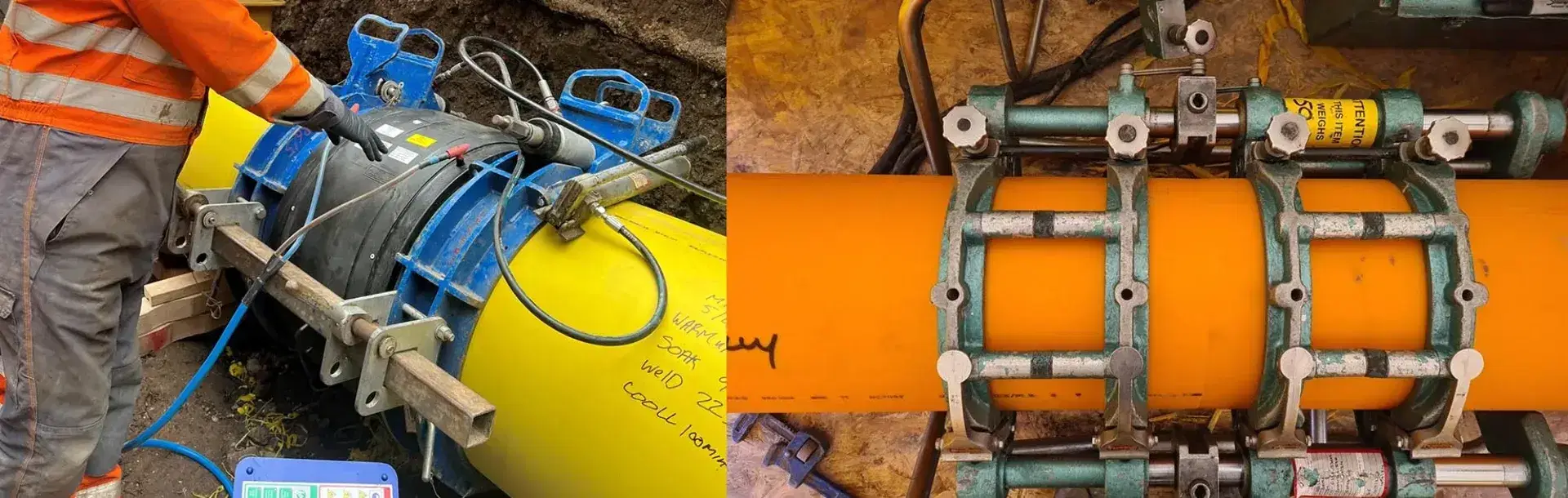
How Do Butt Fusion and Electrofusion Compare? Pros, Cons, and FAQs
PE pipe, or polyethylene pipe is used in water, wastewater and gas distribution networks it is often the material of choice because it’s lightweight, durable, flexible, cheap, reduced maintenance and ease of installation as examples.
PE pipe is available in a variety of pipe diameters and thicknesses, and when it arrives on site it tends to arrive in 6m, 12m or 18m straight lengths or on a coil with lengths 50m or 100m typically, however 200m coils are also available some pipe diameters.
This PE pipe then needs to be welded together to form the pipeline and there’s two main ways of doing this, butt fusion or electrofusion.
The training requirements for both methods are of similar time scale, usually one to two days depending on the experience of the operative, with the skill set for butt fusion a little more intense.
Where are Butt Fusion and Electrofusion Welding techniques used?
- Gas Distribution
- Clean Water Distribution
- Sewers and Drainage
- Land Irrigation
- Ducting Systems
- Industrial Wastewater
- Radiant floor heating
What Is Butt Fusion Welding for PE Pipes?
With Butt fusion the ends of each length of pipe are heated to start to melt the PE, then pushed together so that as they cool, they form a permanent bond together. This type of technique is still the most popular for welding PE pipe.
In Butt Fusion can the pipes be of different wall thickness?
No, must have same wall thickness and SDR (Standard Dimension Ratio) type.
What size pipe is Butt fusion applicable to?
50mm to 2000mm
What are the typical Failures of Butt fusion?
- Inadequate or Incomplete fusion
- Contamination
- Misalignment / Lack of Parallelism
Advantages of Butt Fusion Welding
- Consistent quality
- Cost effectiveness, suitable for large scale pipeline projects
- Versatility
- Strength – the welded joint is as strong as the pipe itself
- Generally quicker than the electrofusion per joint.
Disadvantages of Butt Fusion Welding
- Equipment: Specialised equipment
- Joints: Requires more construction space on site
- Pipe: Must be of the same material, diameter, and SDR
- Contamination: Contaminated scraped areas of pipe, dirt, grease can impact on the weld quality.
- Weather: Extreme weather (i.e. when too hot or cold outside) will require adjustments and can impact on the weld quality.
- Operator: Following of the correct procedures and accurate control of the weld parameters is crucial. Failure to observe cooling times can compromise the weld.
- Installation Time: Longer
What Is Electrofusion Welding for PE Pipes?
Electrofusion uses a specially designed fitting (socket or collar) in which the two ends of the pipe sit into, an electric current is passed through the collar which melts the outside of the pipe and forms a bond. The collar then stays on the pipe and forms part of the pipeline.
In Electrofusion can the pipes be of different wall thickness?
Yes, different wall thicknesses can be accommodated as the electrofusion joint method uses a socket or collar that fits over the pipes to be jointed, and when an electric current is passed through the socket or collar the pipe wall melts attaching the socket or collar to the pipe
What size pipe is Electrofusion applicable to?
16mm to 710mm
What are the typical Failures of Electrofusion?
- Inadequate or no scraping of pipe
- Contamination
- Misalignment
Advantages of Electrofusion Welding
- Electrofusion jointing can be used on water, gas, sewerage and other industrial PE pipe systems and has the advantage of being able to join smaller pipes, from 16mm up to 710mm.
- The plant requirement for electrofusion is less than for butt fusion.
- Different thicknesses of pipes can be jointed together
Disadvantages of Electrofusion Welding
- Equipment: Specialised equipment and a reliance on a power source.
- Fittings: Fitting cost is deemed high
- Joints: Requires less construction space on site
- Contamination: Contaminated scraped areas of pipe can impact on the weld quality.
- Weather: Extreme weather (i.e. when too hot or cold outside) will require adjustments and can impact on the weld quality.
- Operator: Following of the correct procedures and accurate control of the weld parameters is crucial.
- Installation Time: Shorter
| Feature | Butt Fusion | Electrofusion |
|---|---|---|
| Pipe Sizes | 50mm – 2000mm | 16mm – 710mm |
| Joint Strength | Equal to the pipe | High, includes a fitting |
| Equipment | Large, specialised fusion machine | Compact equipment, fittings required |
| Space Requirements | More site space needed | Works in confined areas |
| Pipes Must Match | Yes – same diameter and SDR | No – handles different wall thickness |
| Fitting Cost | No additional fitting cost | Fittings can be costly |
| Use Case | New large-scale pipelines | Repairs, tight access installations |
Frequently Asked Questions
Can you use butt fusion and electrofusion on the same project?
Yes, many projects use both methods depending on the location and pipe size. Butt fusion for open areas; electrofusion for complex or tight spaces.
Is electrofusion or butt fusion stronger?
Both methods create very strong joints, but butt fusion generally produces a weld as strong as the pipe itself, whereas electrofusion strength also depends on fitting quality.
Which is faster to install?
Per joint, butt fusion is generally faster, but electrofusion may be quicker in complex or constrained environments due to easier setup.
Conclusion
In conclusion both Butt Fusion and Electrofusion offer us reliable solutions for joining PE pipes, each have their own advantages and disadvantages (we have only touched on a few). It’s important that when designing your projects designers take these into account and have the knowledge to ensure a suitable design can then be built.
In general, we tend to see that large infrastructure projects favour Butt Fusion and smaller installations, repairs and areas where space is restricted favour Electrofusion, but each project is different.
Why choose Pragmatic Consulting for your Butt and Electrofusion Welding training?
At Pragmatic Consulting, we offer comprehensive training and certification in both butt fusion and electrofusion welding. Our experienced trainers and assessors work across water and gas utilities to ensure you’re fully compliant with industry standards, client expectations, and auditing requirements.
Explore Our Courses:
Let us help your team develop the skills and confidence needed for high-quality, compliant pipe installations.
Read more about Butt Fusion Welding in our blog ‘An Introduction to Butt Fusion Welding’.